
The Future of Aging Is Not a Healthcare ProblemIt is a systems problem.
For decades, aging has been treated primarily as a clinical challenge, something to be managed through care delivery, medical intervention, and late-stage support. That framing is no longer sufficient.
We are living through a fundamental shift.
People are living longer, but not necessarily better. At the same time, advances in artificial intelligence, biotechnology, and HealthTech are redefining what is possible across the lifespan. The result is a widening gap between what we can do and what we are actually prepared to implement.
That gap is where Kairahn works.

Aging Is Being Rewritten in Real Time
The traditional model of aging was linear and predictable. Education. Career. Retirement. Decline.
That model is breaking down.
Today, aging is dynamic, extended, and increasingly shaped by forces that sit outside traditional healthcare systems. Cognitive health, social connection, environment, technology, and purpose all play a role in determining how we experience later life.
At the same time, the pace of innovation is accelerating.
New tools are emerging faster than systems can absorb them. New data is being generated faster than it can be interpreted. New solutions are being built without always understanding the people they are meant to serve.
This is not just a coordination problem. It is a translation problem.
The Gap Is Not Innovation.It Is Understanding.
There is no shortage of innovation in aging.
What is missing is clarity.
Organizations are overwhelmed by signals. Policymakers are navigating incomplete or conflicting data. Innovators are building in isolation from real-world environments.
Too often, solutions are designed without context. Too often, strategy is built without grounded insight. Too often, progress is measured in activity rather than impact.
Closing this gap requires more than expertise. It requires perspective.
Intelligence Must Be Grounded in Reality
At Kairahn, we believe that insight without application is incomplete.
Through Brain Meets Bytes, we surface the ideas, research, and signals shaping the future of brain health and longevity. But understanding what is happening is only the first step.
The more important question is how those ideas translate into the real world.

Through the Intergenerational Lab, we explore that question directly, bringing together younger and older generations to test assumptions, exchange perspectives, and understand how aging is actually experienced across different contexts.
This combination matters.
Because the future of aging will not be determined by theory alone. It will be shaped by how ideas perform in real environments, with real people, over time.

Technology Will Shape Aging. But It Will Not Define It.
Artificial intelligence and emerging technologies will play a central role in the future of aging.
They will influence how we diagnose, monitor, support, and extend cognitive and physical health.
They will reshape care delivery, decision-making, and daily life.
But technology is not neutral.
It reflects the assumptions of those who build it.
It amplifies the systems into which it is introduced.
It creates new opportunities, and new risks.
In aging, those risks are not abstract.
They show up in questions of data ownership, consent, access, and equity.
They shape who benefits, who is left behind, and how trust is built or broken.
We believe that innovation in aging must be guided by both scientific rigor and human understanding.
Not one or the other. Both.
Science First. Human Always.
This principle sits at the center of our work.
Scientific progress is essential. Without it, we do not move forward.
But science alone does not determine outcomes. Human behavior, lived experience, culture, and environment all shape how innovation is adopted and sustained.
The future of aging will not be built solely in labs, boardrooms, or policy circles. It will be built in homes, communities, and everyday interactions.

That is where clarity is tested.

That is where assumptions are challenged.

That is where real progress happens.
The Role of Intergenerational Thinking
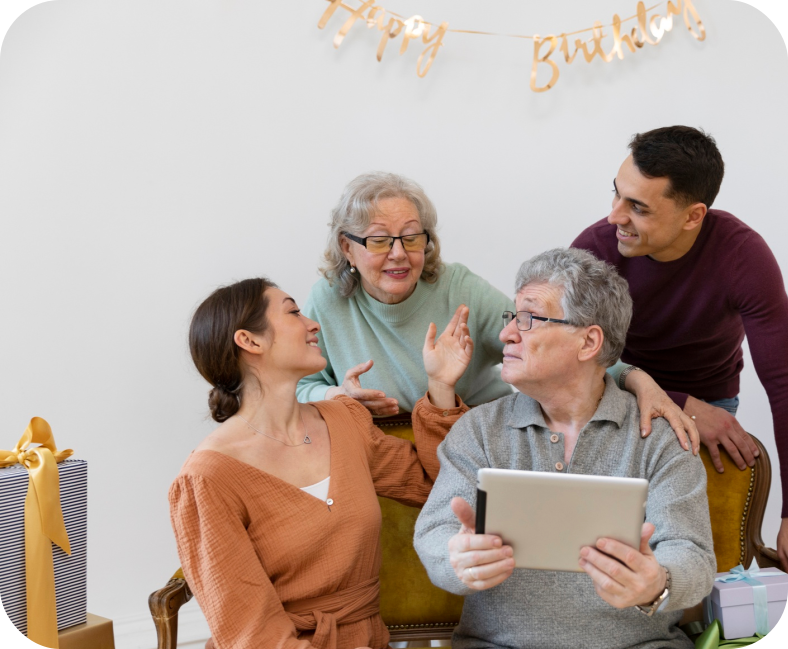
Aging is often framed as a challenge for older adults. In reality, it is a shared experience that connects every generation. The decisions we make today about technology, healthcare, policy, and environment will shape not only how current populations age, but how future generations understand and experience aging itself.
This is why intergenerational engagement is not a side initiative. It is a strategic necessity.
When younger and older generations engage meaningfully, new perspectives emerge. Blind spots become visible. Solutions become more grounded and more durable.
The future of aging depends on these connections.
Where We Focus
Kairahn operates at the point where insight becomes action.
We work with organizations, innovators, and policymakers who recognize that aging is not a niche issue, but one of the defining shifts of our time.
Our role is to help bring clarity to complexity, to connect ideas to application, and to ensure that innovation in aging is both meaningful and sustainable.

Looking Ahead
The next decade will reshape how the world understands aging.
The question is not whether change is coming. It is whether we are prepared to navigate it thoughtfully.
We believe that with the right perspective, grounded in science, informed by real-world experience, and guided by human understanding, that future can be shaped in ways that are more equitable, more effective, and more aligned with how people actually live.
That is the work.